What is peritoneal mesothelioma?
Peritoneal mesothelioma is a rare cancer that starts in the peritoneum. That is the thin lining inside the abdomen that wraps around the organs. It is the second most common form of mesothelioma. Published estimates put it at about 500 to 800 new cases a year in the United States. It is closely linked to asbestos. Among the mesothelioma types it generally has the better outlook, partly because more people with it can be offered surgery.
What are the symptoms of peritoneal mesothelioma?
The most common symptoms of peritoneal mesothelioma are a swollen or bloated abdomen, belly pain, and feeling full after eating little. Many people also have nausea, weight loss they did not try for, tiredness and night sweats. The swelling is often caused by ascites, which is fluid collecting inside the abdomen. These signs are vague, so they get blamed on other things first. Published reviews put the average wait from first symptom to diagnosis at about four to six months. Tell the doctor about any asbestos exposure.
What causes peritoneal mesothelioma?
Peritoneal mesothelioma is caused mainly by asbestos. Tiny fibers are breathed in, coughed up and then swallowed. They reach the lining of the abdomen and damage it slowly over decades. The cancer usually appears about 20 or more years after exposure. That gap is often shorter than for pleural mesothelioma, the kind in the chest, which usually takes 30 to 40 years. Radiation to the abdomen and a rare inherited gene change called BAP1 also raise the risk.
Can you get peritoneal mesothelioma without knowing you were around asbestos?
Yes. Studies disagree on how many people with peritoneal mesothelioma can recall asbestos exposure. Published figures range from under 10 percent to about half, well below the rate seen in the chest form. Exposure was often brief, or second-hand from a family member's work clothes. Talc contaminated with asbestos is one possible source, though the evidence tying talc itself to mesothelioma is limited. Not remembering an exposure does not change the diagnosis or the treatment options.
Is peritoneal mesothelioma the same as stomach cancer?
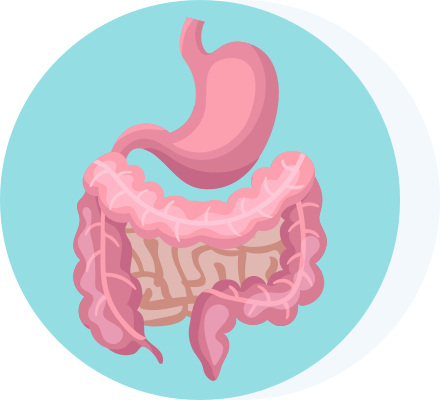
No. Peritoneal mesothelioma is not stomach cancer. It does not start in the lining of the stomach. It begins in the peritoneum, a separate membrane that lines the abdominal wall and drapes over the stomach, intestines and liver. People often search for mesothelioma stomach cancer because the symptoms feel like a stomach problem. The difference matters, because the two cancers are treated in completely different ways by different specialists.
How is peritoneal mesothelioma diagnosed?
Peritoneal mesothelioma is diagnosed with a tissue biopsy, a sample of tumor examined under a microscope. Imaging usually comes first, most often a CT scan of the abdomen and pelvis. MRI or PET scans are sometimes added. Fluid drained from the belly is rarely enough on its own. Doctors normally take solid tissue with a needle, or through a small camera operation called laparoscopy. The laboratory then runs protein stains that separate mesothelioma from other abdominal cancers.
Why is peritoneal mesothelioma so often misdiagnosed at first?
Peritoneal mesothelioma is often misdiagnosed at first because it is rare and its symptoms look ordinary. Bloating, belly pain and fluid buildup get blamed on ovarian cancer, colon cancer or an infection. Under the microscope it can resemble ovarian cancer, so pathologists run a panel of protein stains. Calretinin points toward mesothelioma, while claudin-4 and estrogen receptor point toward ovarian or other carcinoma. A stain called WT1 shows up in both, so it cannot tell them apart. If there is doubt, ask for a second pathology opinion at a mesothelioma center.
What are the stages of peritoneal mesothelioma?
Peritoneal mesothelioma is not staged with the usual stage 1 through stage 4 system. The formal AJCC system covers pleural mesothelioma, the kind in the chest, not this one. Instead, surgeons measure how much tumor is present using the Peritoneal Cancer Index, or PCI. The abdomen is divided into 13 regions, each scored 0 to 3, for a total between 0 and 39. Surgeons also score how completely the tumor was removed at operation, called the completeness of cytoreduction score. A lower score on either one generally means a better outlook.
What is advanced peritoneal mesothelioma?
Advanced peritoneal mesothelioma means the cancer has spread too widely in the abdomen for surgery to remove it all. In practice that usually means a high PCI score, or spread to the small bowel, lymph nodes or outside the abdomen. Late symptoms can include constant belly pain, returning fluid, bowel blockage and severe weight loss. Most of these symptoms can be controlled. Palliative care, which is care aimed at comfort and relief of symptoms, can be given alongside treatment at any stage. Hospice care takes over when treatment is no longer helping.
What is epithelioid peritoneal mesothelioma?
Epithelioid peritoneal mesothelioma is the most common cell type, found in about 75 to 90 percent of cases. Epithelioid means the cells look more like normal lining cells, and this type responds best to treatment. The others are biphasic, a mixture, and sarcomatoid, which has spindle-shaped cells. Chemotherapy means drugs that kill cancer cells. In published series of patients given surgery plus heated chemotherapy, median survival was about 55 months for epithelioid disease. For biphasic disease it was about 13 months, and individual results vary widely.
What is the life expectancy for peritoneal mesothelioma?
Life expectancy varies widely in peritoneal mesothelioma, so no single number fits everyone. In a 2009 registry of more than 400 patients at 29 specialist centers, median survival was 53 months. Those patients were all chosen for cytoreductive surgery plus heated chemotherapy, so they do not represent everyone with this diagnosis. A median of 53 months means half of that group lived longer and half lived less. It is not a prediction for any one person. People who cannot have surgery and have chemotherapy alone have averaged closer to one year.
What is cytoreductive surgery with HIPEC, and who can have it?
Cytoreductive surgery with HIPEC, or heated intraperitoneal chemotherapy, is the main treatment when the disease can be removed. The surgeon removes all visible tumor, then bathes the abdomen in chemotherapy heated to 106 to 109 degrees Fahrenheit. It often runs 6 to 12 hours, and recovery takes months. Eligibility depends on how far the tumor has spread and on overall fitness. Published series from experienced centers report serious complications in 20 to 40 of every 100 patients. About 2 to 4 in 100 die within 30 days, so ask for a high-volume center.
Is immunotherapy used to treat peritoneal mesothelioma?
Immunotherapy is sometimes used for peritoneal mesothelioma, but no immunotherapy drug is FDA approved for it. Immunotherapy means drugs that help the immune system attack cancer. Both FDA approvals were written for pleural mesothelioma, the kind in the chest. Those are nivolumab plus ipilimumab in 2020, and pembrolizumab with chemotherapy in September 2024. Doctors sometimes use these drugs off-label for peritoneal disease. In a single-arm trial of 20 patients, atezolizumab plus bevacizumab shrank tumors in 40 percent, an early result in very few people.
Should we ask about a clinical trial?
Yes, ask about clinical trials, and ask early rather than only after other treatments stop working. No drug is FDA approved specifically for peritoneal mesothelioma, so much of the best care is being tested in trials now. Specialty reviews recommend that people with this cancer be treated at high-volume centers, with strong consideration given to clinical trials. Ask your loved one's team what they might be eligible for. Ask again if the situation changes. You can also search at ClinicalTrials.gov.
Is peritoneal mesothelioma curable?
Peritoneal mesothelioma is usually not curable. For a small number whose disease is still limited to the abdomen, specialist centers sometimes aim at long-term control. A specialist is the person who can say whether that applies to your loved one. In a series of 211 patients treated at three US centers with surgery and heated chemotherapy, median survival was 38 months. In that group 41 percent were alive at five years and 26 percent at ten. Those were selected surgical patients, and reaching a center that does this surgery often helps most.